Shopping for swimwear for body shape can become oddly abstract. One rack tells you to create curves, another tells you to minimise them, and neither tells you whether the top will stay put when you reach for a towel. A useful swimsuit starts with a simpler question. Does it support the parts that need support, cover the parts you want covered, and let you move without spending the day adjusting it? Body shape can suggest styles to try, but the fitting-room checks decide whether a suit earns a place in your bag.
Ignore the label and start with support
Size labels are a rough sorting tool, not a measurement of success. Put on the swimsuit, lift both arms, bend to pick up an imaginary beach bag, and take a few long steps. The band on a bikini top should sit level around the ribcage rather than riding upward. If the straps are doing all the work, the band is probably too loose; tightening straps further often creates shoulder dents without improving support. For a fuller bust, an underwire, firmer shelf, or bra-sized top can make the fit noticeably calmer.
Support is not only a bust issue. A one-piece with a low back, loose lining, or thin elastic may feel fine under fitting-room lights and become slippery after a swim. Check the fabric at the side seams and under the arms. It should lie flat without cutting in sharply, but it should not gape when you twist. A swimsuit is meant to be snug when dry because water loosens it slightly. Painful compression is not the same as secure fit.
Choose a one-piece or two-piece for your own proportions
Neither a bikini nor a one-piece belongs to one body type. A two-piece is useful when your top and bottom need different sizes, or when a long torso makes standard one-pieces pull at the shoulders. It also lets you choose coverage separately: a supportive top with a higher-waist bottom can solve two fit needs without compromise. When trying a bikini, look at where the waistband lands when you sit. A band that folds or rolls is more likely to annoy you after an hour on a sun lounger.
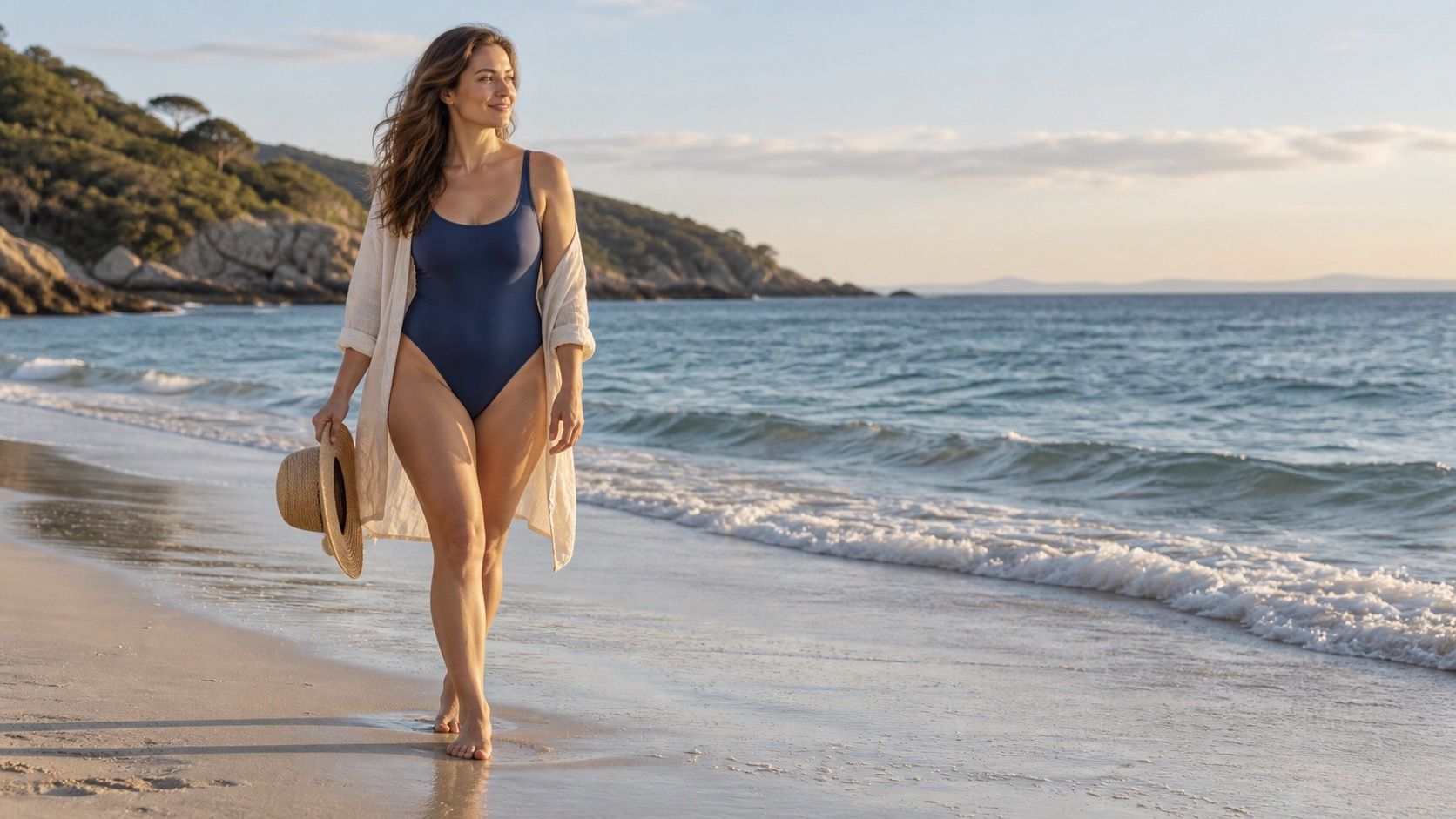
A one-piece can feel streamlined, but its torso measurement is crucial. If the shoulder straps tug, the leg openings pull upward, or the neckline shifts when you raise an arm, look for a long-torso option or adjustable straps before changing size. Going up a size may add width where you do not need it while leaving the length problem unsolved. Wrap fronts, diagonal seams, and a defined waist can give a one-piece more visual shape, while a simple athletic cut is often practical for laps, paddleboarding, or chasing children into shallow water.
Use straps, cups, and torso length as fit controls
Straps are small pieces of hardware with a large effect. Wider straps distribute pressure and are less likely to dig in, especially on a larger bust. Adjustable straps help when shoulders are narrow or when one shoulder sits slightly differently from the other, which is common and not a flaw to correct. Halter ties can offer lift, but test them for ten minutes rather than one mirror pose; neck strain is a poor trade for a dramatic neckline. Cross-back straps usually feel stable for active beach days, provided they do not pull the suit too high at the underarm.
Cups need enough depth as well as enough width. Flattening across the bust, overflow at the top edge, or a cup that sits away from the body are fit clues, not reasons to blame your shape. Removable pads can smooth the outline but may bunch after swimming; take them out, reposition them, and decide whether the suit still works. On a long or short torso, details such as a high neckline, a belt, or a colour block will change visual balance, but comfort at the shoulder and crotch seam comes first.
| Fit concern | What to check | Useful starting point |
|---|---|---|
| Top rides up | Band stays level when arms lift | Firmer band, underwire, or adjustable back |
| One-piece pulls | Shoulders and leg openings stay relaxed | Long-torso cut or adjustable straps |
| Bottom shifts | Waistband stays put while sitting | Wider waistband or a more secure rise |
| Leg opening feels harsh | Elastic lies flat without pinching | Moderate cut and softer elastic finish |
Check coverage and leg openings in motion
Bottoms are often sold with language about making legs look longer or hips look smaller. Those claims are less useful than knowing how a cut behaves. A higher leg opening exposes more hip and can feel freeing for some people; on others it may creep upward during a walk. A lower opening gives more coverage but can feel restrictive if the elastic is too firm. Try the same style in two rises if possible. Mid-rise, high-rise, and low-rise bottoms create different visual break points, yet the right choice is the one that does not demand constant pulling.
Coverage at the back is personal, not a test of confidence. Moderate coverage is often easiest for swimming and sitting on textured pool furniture. A fuller-cut bottom can be excellent if the waistband is secure and the fabric does not sag after a dip. If you prefer a more minimal cut, inspect the inner construction: double lining and a well-finished centre seam reduce shifting. A skirted bottom or swim short can be useful for walking to a café, but it should still be comfortable in water rather than treated as a cover-up that happens to be wet.
Treat colour and detail as preferences, not correction tools
People often arrive at the beach with a list of features they were told to hide. That framing makes it hard to notice what they actually enjoy wearing. Dark colours, bright solids, prints, ruching, belts, and cut-outs can all be appealing, but none has a universal job. If you like a bold print on top, pair it with a simpler bottom because that feels intentional to you, not because a chart says it balances your body. Look at the suit from the side as well as the front; placement of seams and ties matters more in motion than in a flat product photo.
Texture deserves a practical check. Ribbed fabric, crochet overlays, and shiny finishes can look beautiful, but some take longer to dry or become less opaque in water. Stand near a window, wet a small inconspicuous area if the store allows it, and stretch the fabric gently. Pale colours and white lining deserve extra attention. A suit that looks polished only when completely dry is not necessarily a good beach companion.
Test swimwear before committing to a full beach day
The best swimsuit for body type is usually the one that disappears from your attention after five minutes. Before removing tags, wear it at home for a short stretch: sit on a chair, reach overhead, walk up stairs, and move as though you are drying off. Notice whether straps slide, the neckline gaps, or the bottom feels different when you sit. Keep the return policy intact while you decide; a clean, dry fitting is more informative than a hurried verdict in a tiny changing room.
For a first beach trip in a new suit, pack a second option if you can. Conditions change: a calm pool day, a windy shore, and a day of swimming require different levels of security. Build a small rotation around comfort rather than a body-shape rulebook. One supportive bikini top, one reliable bottom, and one one-piece you can move in will serve most people better than a drawer full of styles that only work while standing still.