Kibbe body types are often presented online as a fast quiz: answer a few questions about your shoulders and eyes, receive a label, then rebuild your wardrobe. That is not a very faithful or helpful way to approach the system. David Kibbe’s Image Identity framework is a style concept about the overall impression created by line, shape, and personal presence. It is not a measurement chart, a diagnosis, or a reason to inspect your body for flaws. For beginners, the most useful goal is learning to see clothing lines more clearly.
Why Kibbe is not a standard body-shape chart
A body-shape chart usually sorts outlines into names such as pear, rectangle, hourglass, or inverted triangle. Those categories focus mainly on the relationship between shoulders, waist, and hips. Kibbe types explained in plain language are doing something broader: they consider the total blend of vertical line, bone structure, flesh, facial features, and the way clothing reads as a whole. Two people who both identify with an hourglass outline may be drawn to very different Kibbe recommendations because their overall line is different.
This distinction matters because it prevents a common mistake: using the system to hunt for a smaller waist, longer legs, or a more conventionally balanced figure. The framework is not designed to correct a silhouette. It asks whether a garment’s shape has enough crispness, softness, length, symmetry, or relaxed movement to work with the person wearing it. A well-fitting black blazer is not automatically suitable or unsuitable because of a type label; its shoulders, fabric, lapels, length, and styling all contribute to the result.
Read yin and yang as visual language, not as a score
In Kibbe language, yang generally refers to sharper, longer, straighter, or more angular visual qualities. Yin refers to softer, rounder, smaller-scale, or more delicate qualities. Most people are not a pure example of either. The system is interested in the blend and in how that blend appears across the whole person. The words can sound loaded, but they are simply shorthand for design qualities. A sharply cut collar has more yang than a rounded Peter Pan collar; a draped knit has more yin than a stiff, squared jacket.
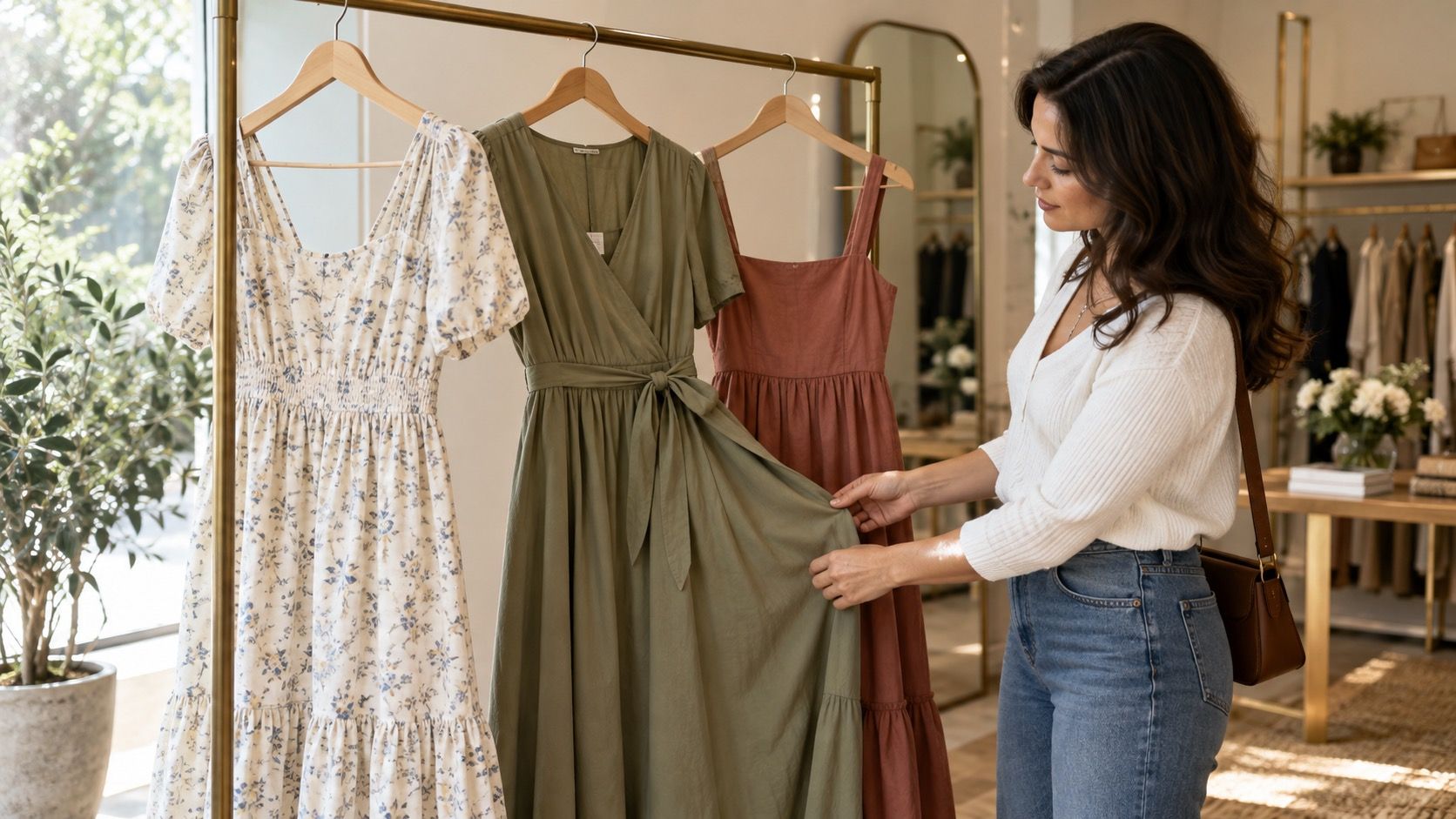
It helps to look at garments before looking at yourself. Lay out a crisp white shirt, a softly gathered blouse, a long straight coat, and a rounded cardigan. Notice what changes: edge sharpness, fabric weight, drape, scale, and symmetry. This exercise turns abstract terms into visible choices. It also makes room for preferences. You may appreciate a structured coat even if a softer top is often more harmonious, or enjoy a dramatic shoulder occasionally because fashion is allowed to be playful.
Understand the main Image Identity families without memorizing every type
Most beginner summaries group the Image Identities into families: Dramatic, Natural, Classic, Gamine, and Romantic, with related identities that combine or soften those broad directions. Dramatic family guidance tends to explore elongation and sharper geometry. Natural guidance often considers width, relaxed construction, and texture. Classic guidance centers on balance and moderation. Gamine combines contrast and compact, animated shapes, while Romantic explores curve, softness, and ornate detail. These descriptions are entry points, not boxes with locked doors.
The family level is often enough at first. If you are deciding between a clean, symmetrical outfit and a relaxed, textured one, it is more useful to test both than to panic over whether a feature sounds “exactly” like one subtype. Photographs can distort scale, posture, and line. Celebrity examples are especially unreliable because styling, tailoring, posing, and image editing do a great deal of work. Your own wardrobe experiments provide better evidence than a side-by-side collage.
| Design quality | What it can look like in clothing | A simple way to test it |
|---|---|---|
| Vertical or elongation | Long uninterrupted lines, longer jackets, column dressing | Compare a short layer with a longer open layer |
| Sharpness | Crisp collars, pointed shoes, clean tailoring | Try one structured item with otherwise simple pieces |
| Softness | Drape, rounded edges, lighter gathers | Swap a stiff shirt for a fluid blouse in the same outfit |
| Relaxed width | Unconstructed jackets, open necklines, textured fabric | Check whether ease looks intentional or merely oversized |
| Symmetry | Matched details, moderate scale, centered closures | Compare an even neckline with an asymmetrical one |
Explore a Kibbe body type test slowly and with real clothes
Many online Kibbe body type tests ask for isolated body parts: broad versus narrow shoulders, large versus small eyes, long versus short limbs. These questions can be hard to answer objectively, and they encourage close scrutiny that rarely improves anyone’s style. A better beginner method is to make a small fitting-room experiment at home. Choose a few garments with genuinely different lines: one structured, one draped, one relaxed, one symmetrical, and one high-contrast. Photograph each full outfit from the same distance in ordinary daylight.
Then ask practical questions. Does the garment hang cleanly, or does it look like it arrived before you did? Do the details feel visible in a good way, or do they distract from your face? Can you move and sit comfortably? Which outfit looks most coherent without relying on a special pose? Keep notes over several weeks, because one outfit can be influenced by mood, hair, shoes, or an awkward photograph. The pattern that repeats is more useful than a single verdict.
Use fit and lifestyle as the non-negotiables
Image Identity guidance cannot override fit. A jacket may have the right line on paper but fail because the shoulder seam sits too far down, the sleeve is too tight for driving, or the fabric feels scratchy. Likewise, a skirt that looks excellent for an evening may be irrelevant if you spend your days walking, caring for children, or working in a casual office. Keep a fit checklist alongside any style experiment: shoulder placement, waist comfort, range of motion, hem behavior while sitting, and whether you will actually reach for the item twice a week.
Tailoring can clarify a garment’s line more than buying another recommended piece. Shortening a sleeve, moving a button, adjusting a waist, or hemming trousers to work with your usual shoes may transform an almost-right item. It is worth doing this with a favorite garment first. That gives you a concrete reference point for future shopping and reduces the temptation to buy five versions of an idea you have not yet tested.
Know when Kibbe advice is becoming unhelpful
The system stops being useful when it makes your closet smaller, your body more scrutinized, or your taste less audible. No Image Identity needs to ban jeans, color, sneakers, a certain neckline, or a beloved vintage piece. Recommendations are meant to describe patterns of harmony, not issue permissions. If a strict list makes you anxious, return to the simpler question: what lines, fabrics, and scales make you feel comfortable and present?
Use Kibbe as a vocabulary for noticing, then let personal style make the final decision. You can borrow a relaxed texture from Natural ideas, symmetry from Classic styling, or a strong vertical line from Dramatic dressing without proving that you belong to any one group. The most durable result is not a perfectly defended label. It is a clearer understanding of why one outfit lets you get on with your day and another keeps asking for attention.