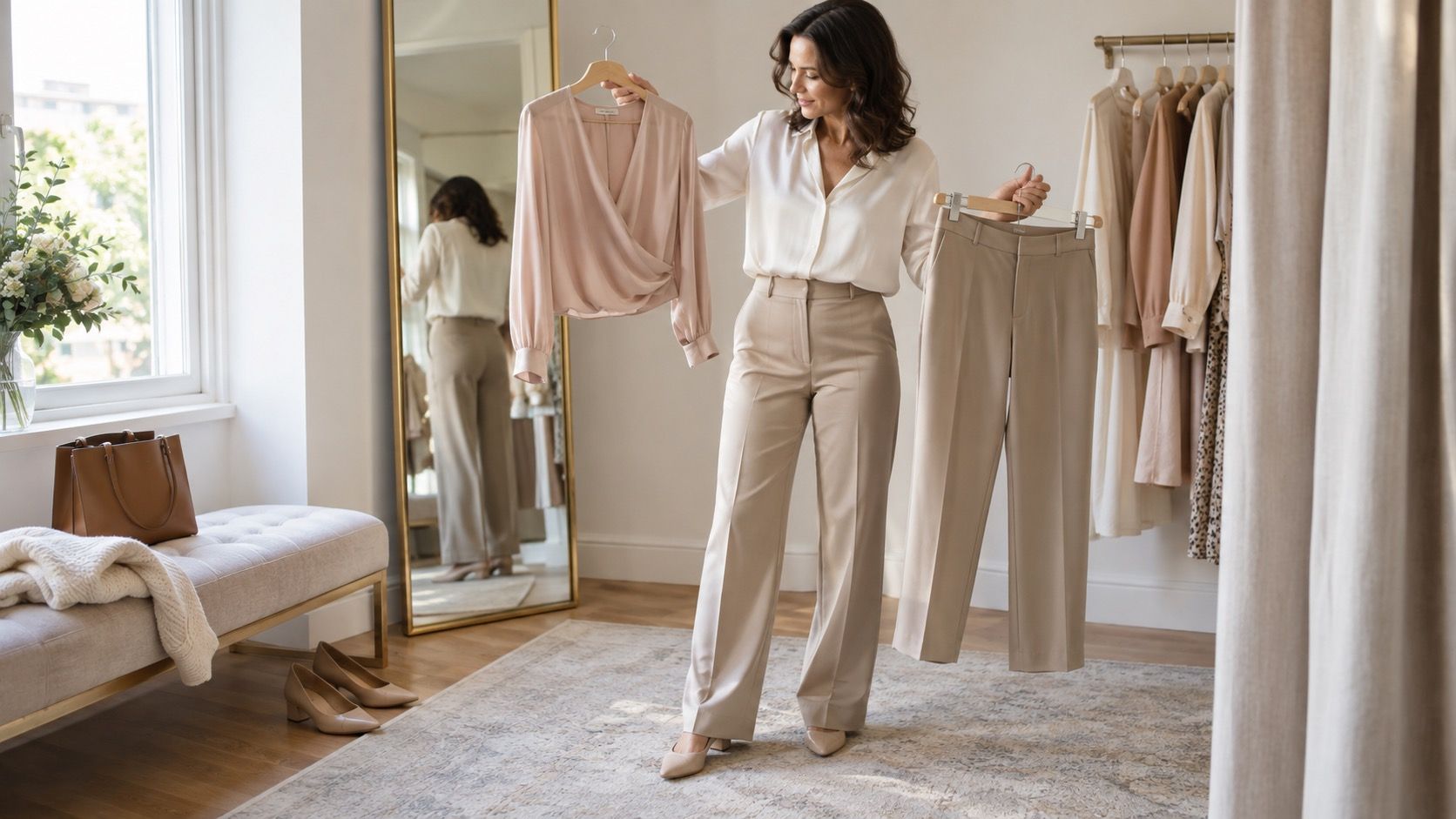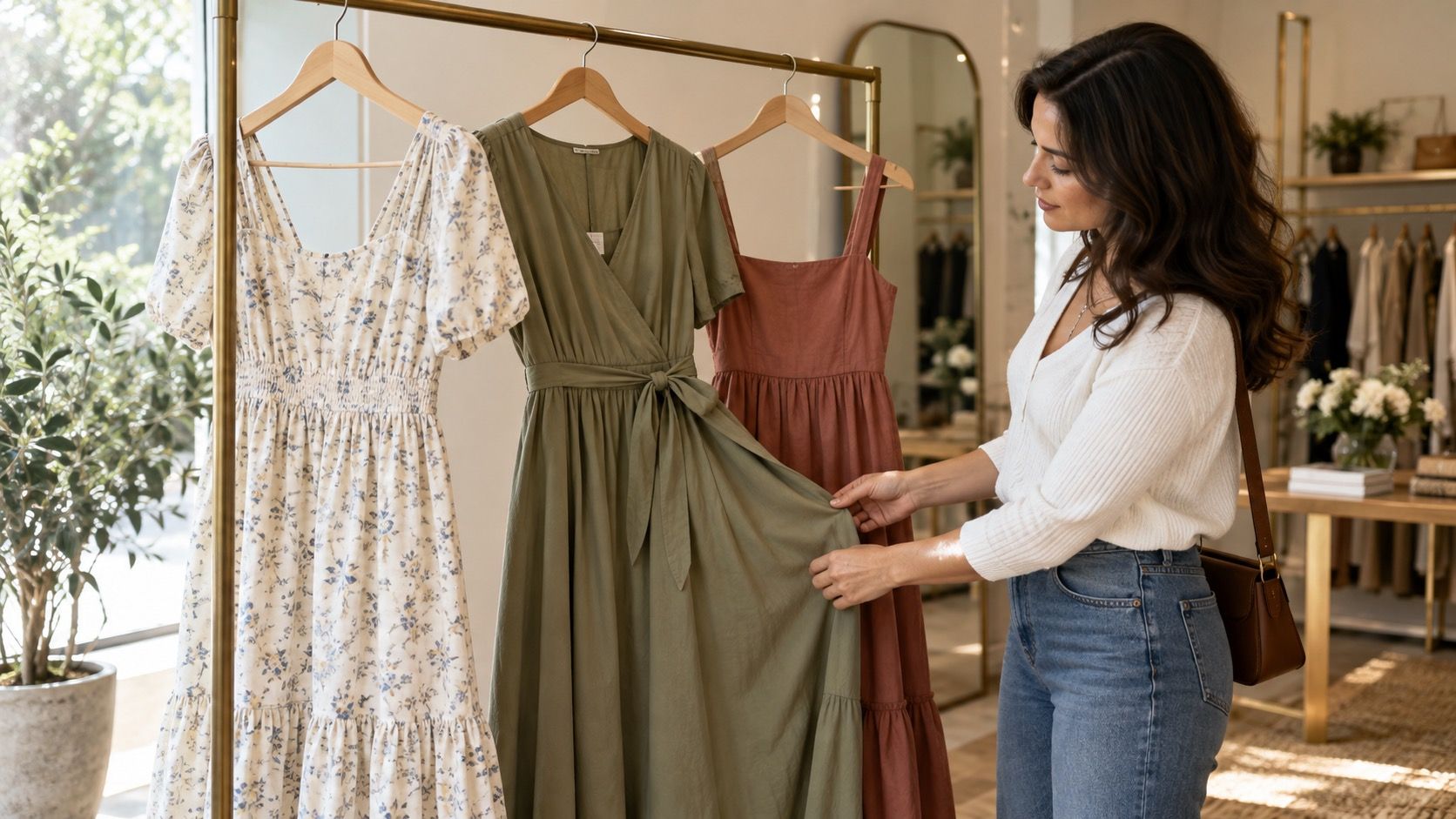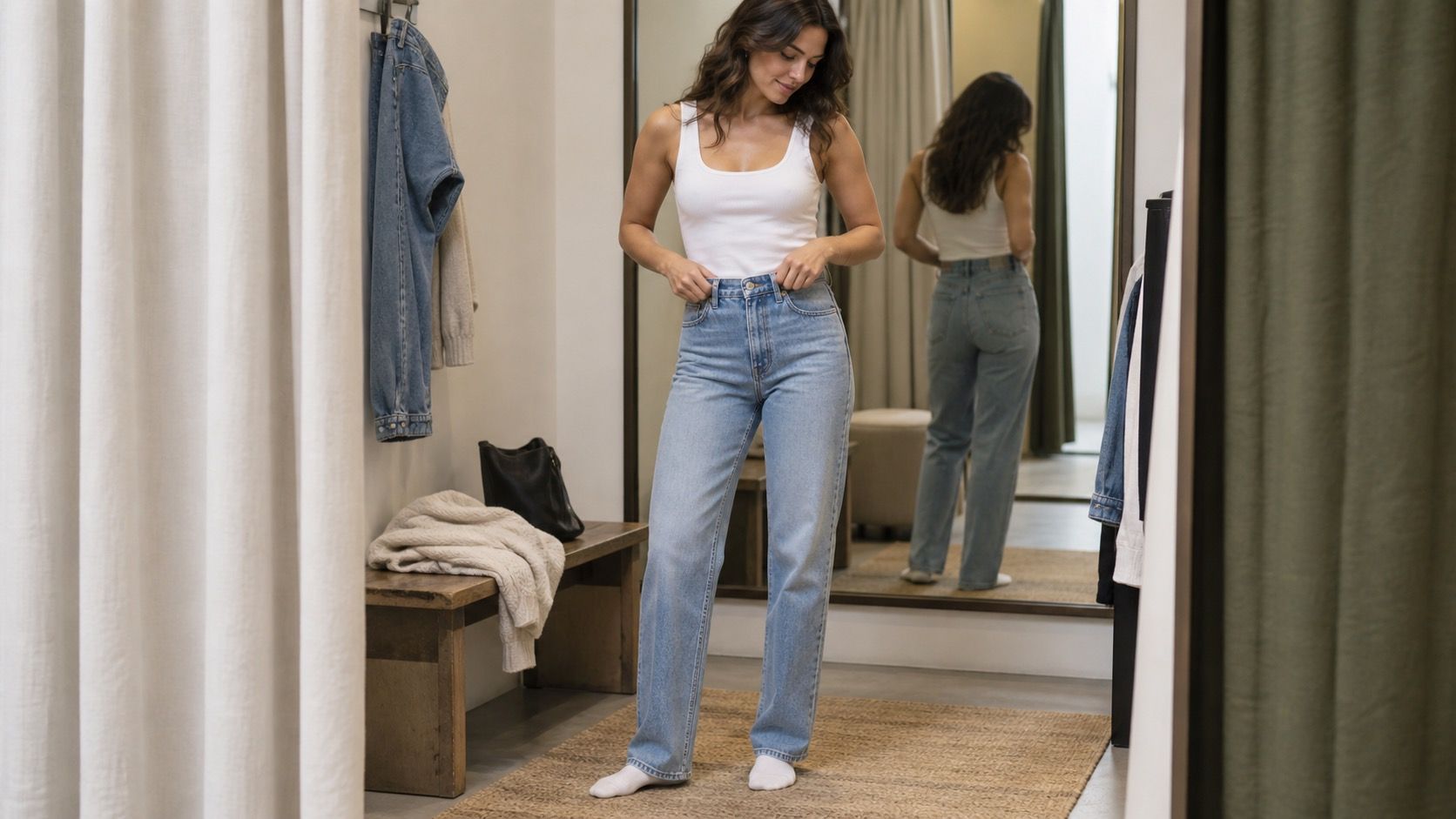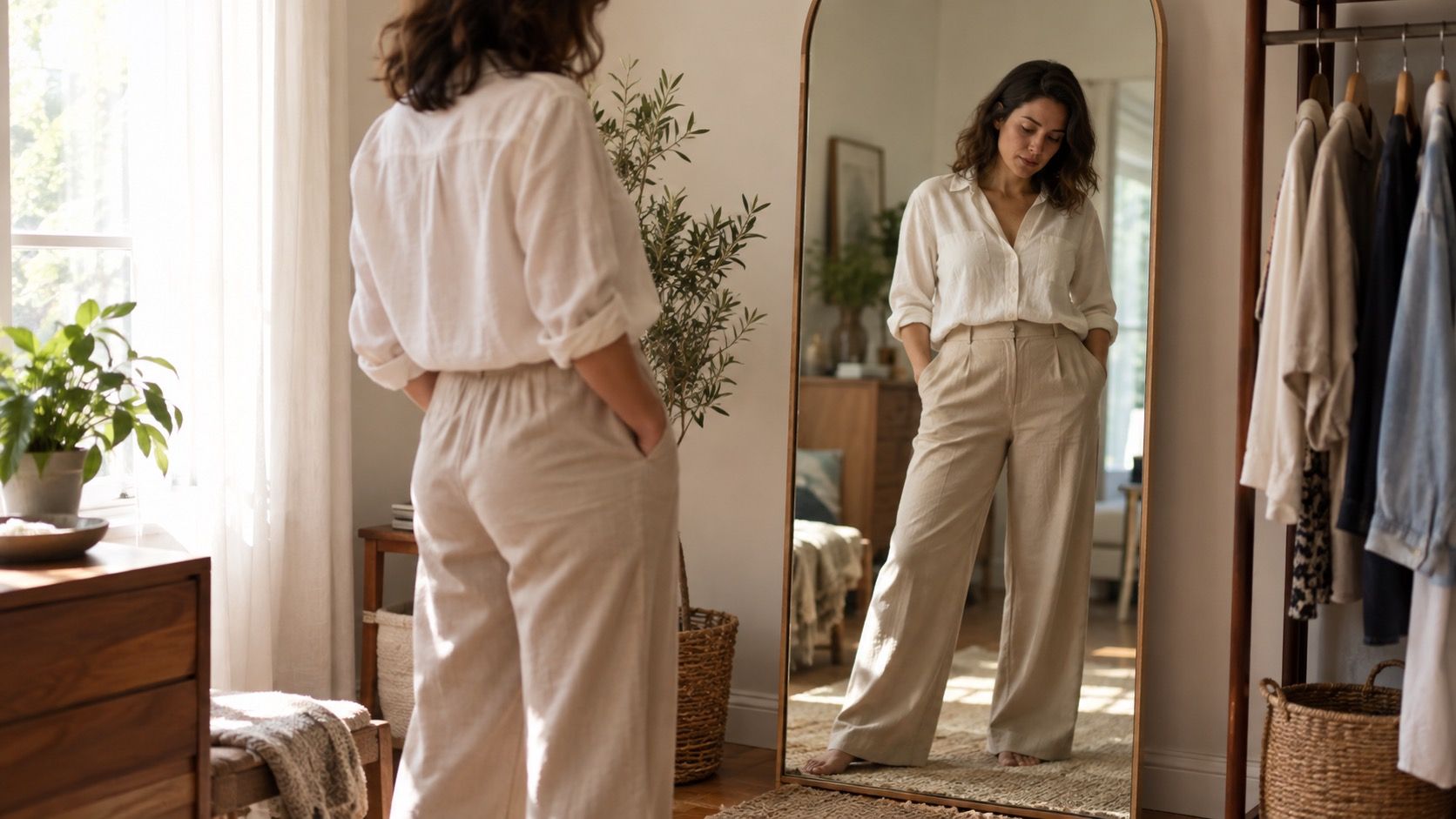
If you have ever taken a body type quiz and received a result that did not resemble your reflection, you are not alone. Body-shape labels are shorthand for proportions, not diagnoses and not rules about what you may wear. The useful question is simpler: where does your silhouette gain width, where does it narrow, and which cuts let you feel at ease when you sit, walk, and look at yourself from more than one angle?
Begin with proportion before you name anything
Put on close-fitting clothes and stand in front of a full-length mirror with your arms relaxed. Look first at the relationship between shoulders, bust, waist, and hips, rather than at individual body parts. A pronounced waist with similarly balanced upper and lower width may suggest an hourglass pattern. Hips that carry more visual width than the upper body may suggest pear. A straighter line through the waist may read as rectangle. These are descriptions, not grades.
Do this in ordinary daylight if possible. Overhead bathroom lights can exaggerate shadows and a phone camera held too low can distort your frame. Take note of the outline from the front and the side. A body can look balanced from the front while a fuller bust or a rounded seat changes the side view and therefore the fit of shirts, dresses, and trousers.
Compare shoulders, bust, waist, and hips with a tape
Measurements give a useful second opinion when the mirror is inconclusive. Use a soft tape around the fullest bust, the natural waist, and the fullest hips; measure shoulders from outer point to outer point with help if you can. Keep the tape level, stand normally, and avoid holding your stomach in. The numbers do not need to be laboratory-perfect. You only need enough consistency to see the relative pattern.
Write down the figures and compare differences instead of staring at one number. A waist that is notably smaller than both bust and hips often matters more for fit than whether your bust and hips differ by an inch. Broad shoulders can make a bust-and-hip comparison misleading, while a fuller high hip can change how a skirt sits. This is why a body type quiz should be treated as a prompt to observe, not an answer key.
| What you notice | Possible shorthand | Best next check |
|---|---|---|
| Shoulders or bust look wider than hips | Inverted triangle | Try a structured shoulder and a relaxed wide-leg bottom |
| Bust and hips similar with a distinct waist | Hourglass | Compare a wrap dress with a straight shift |
| Hips look wider than shoulders | Pear | Test different necklines and trouser rises |
| Waist, bust, and hips read fairly even | Rectangle | See whether shape comes from cut, texture, or a belt |
| Fullness is most visible through the middle | Apple | Check vertical lines and shoulder fit before sizing up |
Use photos, but remove the posing tricks
A photo can make proportions easier to see because it gives you a little distance from familiar details. Set a phone at about chest height, step back far enough to avoid wide-angle distortion, and take a front, side, and back photo in the same simple outfit. Stand as you would while waiting for a bus, not as if you are about to walk a runway. A hand on one hip, a turned knee, or a dramatic arch can create a shape that is not there in everyday life.
Do not use the photograph to pick faults. Look for practical signals: where a jacket ends, whether a waistband cuts across the torso, and whether a dress pulls at the bust or hips. Compare a few different silhouettes in the same setup. The aim is to learn why one shirt disappears on you while another looks deliberate, not to make your body conform to a chart.
Expect overlap and changes over time
Mixed shapes are common. You might have pear-like hip proportion with broad shoulders, or an hourglass waist that reads straighter in loose clothes. Height, torso length, muscle distribution, and personal styling all alter the visual result. Seasonal weight changes, a new training routine, pregnancy, or menopause can shift measurements too. There is no need to retire a label with ceremony; it was only ever a tool.
It also helps to separate body shape from style identity. Someone with an apple body shape may love crisp tailoring; someone with an hourglass shape may prefer roomy linen. The label can suggest fit problems to watch for, such as shoulder strain or a waist gap, but it cannot tell you whether you enjoy a colour, a hem length, or a dramatic sleeve.
Turn your result into small clothing experiments
Choose one category of clothing you wear often and run a quiet comparison. For trousers, try two rises and two leg shapes in the same approximate size. For dresses, compare a defined waist with a straighter cut. For tops, notice whether a boat neck, V-neck, crew neck, or open collar changes the balance you see. Keep fabric similar when you can, because stiff denim and soft jersey can create different silhouettes from the same pattern.
The best result is a personal set of notes: a high-rise waist feels secure but needs room at the hip; cropped jackets work with dresses but not long tunics; sleeves need a little extra ease at the upper arm. That evidence is more durable than any answer to what is my body shape. It gives you a practical way to shop and a gentler way to decide what deserves a place in your wardrobe.
Keep the label light as your wardrobe changes
It is worth revisiting your observations when you buy a different bra, change activity levels, recover from an injury, or simply realise that your usual uniform no longer feels like you. Measurements may move a little, but your preferences can move much more. A former favourite can become irritating because its fabric is scratchy, its waist seam is in the wrong place, or its care routine is too demanding. None of that needs a new body-shape category to be valid.
When a sales page or quiz promises a final answer, take the useful part and leave the certainty behind. Your body is not a problem set with five possible solutions. Use a body-shape label to generate a few useful fitting-room tests, keep the pieces that work in a real week, and let the rest of your style be driven by colour, comfort, weather, work, and mood.